
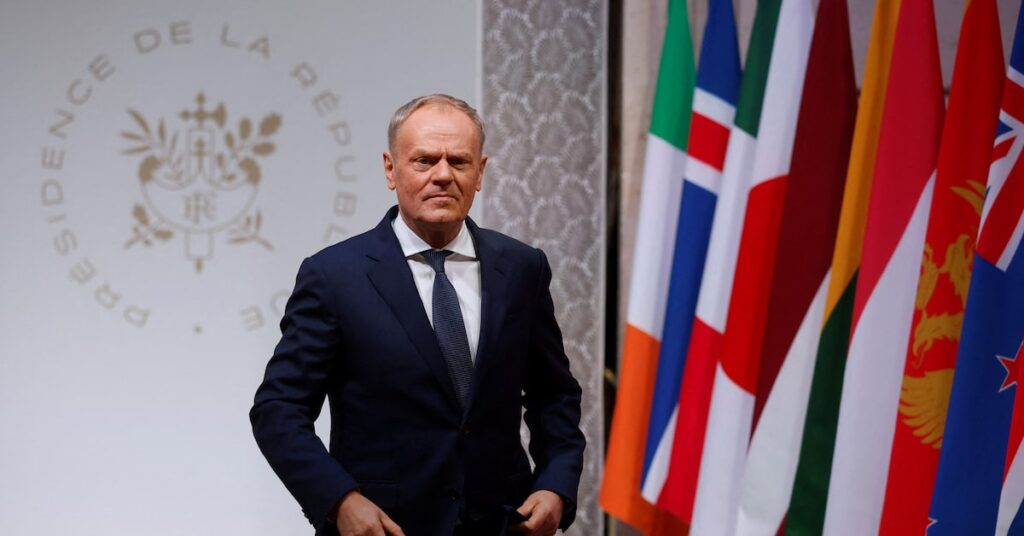

NATO’s unity is cracking, and the fallout could rip the post‑Cold‑War security architecture to shreds. Polish Prime Minister Donald Tusk has warned that a clash between allies would “be the end of the world as we know it”, while two high‑profile disputes – a US‑driven push on Greenland and Turkey’s unilateral air‑policing deployments to the Baltic and Romania – already expose the fault lines. If the alliance cannot mend these rifts, the guarantees that have underpinned Central and Eastern Europe for three decades may evaporate.
The Greenland row erupted in mid‑January when former US President Donald Trump boasted on Truth Social that the United States considered the Arctic territory “a strategic asset that must be in U.S. hands”. A subsequent meeting of Danish and Greenlandic foreign ministers with senior US officials in Washington set the stage for a potential NATO‑backed foothold. Poland reacted with an unambiguous refusal to send troops, declaring any attempt by a NATO member to annex part of another “a political disaster” and “the end of the world as we know it”. Germany framed the US move as a reconnaissance effort against Russian and Chinese activity, while Sweden dismissed the threat as exaggerated. Denmark called for “more work … to find a common way forward”, and Russia’s embassy warned that the manoeuvre would “exploit tensions to expand its Arctic footprint under a false pretext”. Analyst Nicole Covey notes that NATO has never faced an internal territorial dispute of this nature, underscoring how novel the challenge is.
In parallel, Turkey announced a four‑month rotation of fighter jets to Estonia from August to November 2026, followed by a second stint in Romania from December 2026 to March 2027. The deployment is billed as a “significant contribution to NATO’s air‑policing operations” aimed at countering Russian airspace violations. What sets this mission apart is its unilateral nature: the Turkish defence ministry issued the schedule without the usual multilateral planning that governs forward‑deployed forces. Estonia’s defence ministry welcomed the reinforcement, and Romania described it as a “significant contribution”, but neither comment addressed the lack of coordinated NATO endorsement, hinting at unease over command‑and‑control integration.
Tusk’s warning, delivered in early January, links these disputes directly to the security of Poland and its neighbours. He warned that any attempt by one NATO state – or the United States – to seize another’s territory would be catastrophic, and he reiterated Poland’s refusal to participate in any Greenland mission. His rhetoric frames the issue not as a diplomatic spat but as an existential threat to the alliance’s collective defence guarantee under Article 5.
The immediate implication for Central and Eastern Europe is a erosion of the consensus‑based decision‑making that has historically enabled rapid, unanimous responses to crises. If member states cannot agree on non‑military, territorial matters, the confidence that forward‑deployed multinational battle groups can be reinforced swiftly may falter. Poland’s outright refusal to back a Greenland operation signals a willingness among some allies to block US‑led initiatives perceived as infringing on sovereignty, raising the spectre of delayed reinforcements on the eastern flank.
Turkey’s ad‑hoc air‑policing rotations, while bolstering short‑term air‑defence coverage for Estonia and Romania, also set a precedent for national forces operating semi‑independently of the integrated NATO command structure. Such unilateral deployments risk creating a patchwork of national contingents with divergent rules of engagement, complicating the alliance’s ability to mount a coherent collective response under Article 5. If more members emulate this model, NATO’s force posture could become fragmented, undermining the seamless interoperability that has been its hallmark.
Strategically, the Greenland dispute reflects a widening US‑Europe split over priority theatres: the United States eyes the Arctic as a new front against Russian and Chinese activity, while many European allies remain focused on the eastern European threat corridor. A reallocation of resources toward the high north could dilute the deterrence posture that underpins security in Poland, the Baltic states and Romania. Conversely, Turkey’s focus on Baltic and Romanian air‑space reinforces the eastern emphasis but does so through a unilateral lens that may encourage other members to pursue national‑first initiatives, further straining alliance cohesion.
The bottom line is stark: without swift diplomatic engagement to restore trust and reaffirm the primacy of collective decision‑making, the alliance’s foundational security guarantees risk unraveling. Tusk’s stark warning should serve as a catalyst for NATO to confront these fissures head‑on; otherwise, the post‑Cold‑War order that has kept Central and Eastern Europe under the protective umbrella of the alliance could indeed begin to crumble.
Image Source: www.reuters.com