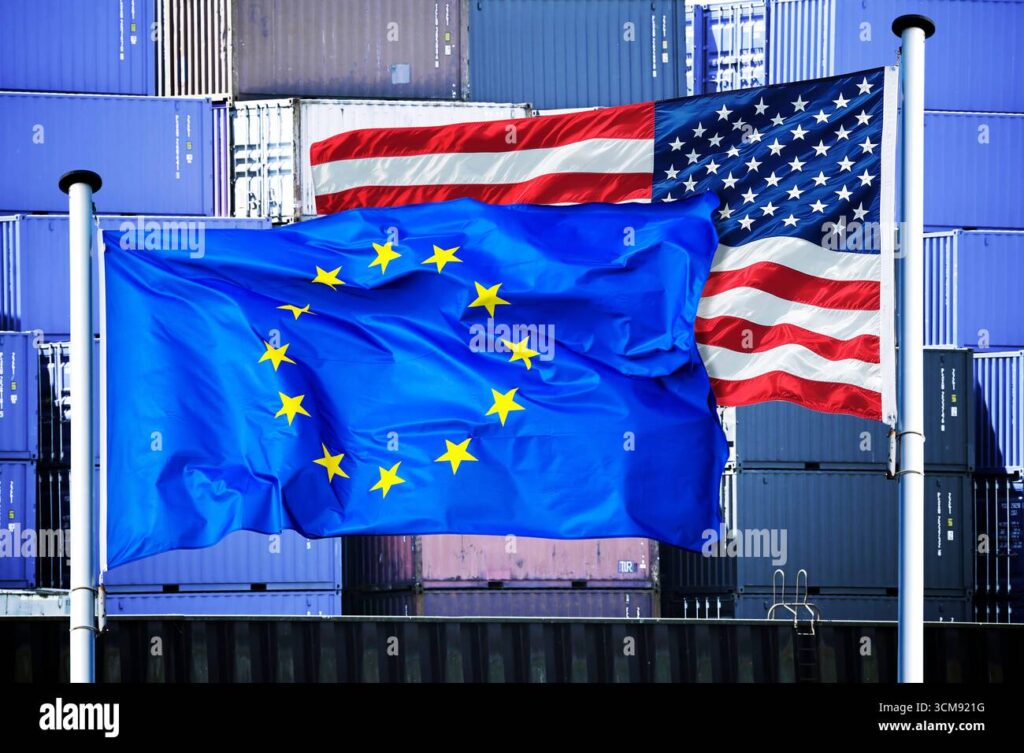

The United States is set to slap a 10 % duty on imports from eight European nations next February, with a steep jump to 25 % by June – a move that could reverberate through the EU’s post‑communist heartlands.
The tariff schedule is crystal clear: from 1 February 2025 a uniform 10 % ad‑valorem charge will hit goods arriving from Denmark, Norway, Sweden, France, Germany, the Netherlands, Italy and the United Kingdom. If the dispute remains unresolved, the rate automatically escalates to 25 % on 1 June 2025. The package was unveiled by President Donald Trump in October 2024 as “reciprocal” retaliation for European resistance to a U.S. bid for a strategic foothold in Greenland.
What remains murky is exactly which sectors will feel the pain. Open‑source reporting from Reuters, Brookings and UNCTAD confirms the headline rates and the list of countries, but none of the articles disclose product‑level breakdowns. Consequently, the presumed exposure of Danish pork, Norwegian salmon, Swedish steel, French wine, German automotive parts, Dutch horticulture, Italian fashion or British pharmaceuticals cannot be verified. Without customs data or HS‑code analysis the economic impact on agriculture, heavy industry and high‑tech remains speculative.
The political spark for the tariffs was Washington’s frustrated push to acquire a greater strategic presence in Greenland – a move spurned by Europe and denounced as a breach of the Arctic consensus. Trump’s October 2024 proclamation framed the duties as a direct response to European opposition, turning a geopolitical spat into a trade weapon. The timing, coinciding with the United States’ broader shift toward protectionism in early 2025, underscores how quickly diplomatic friction can be weaponised on the market.
So far, the diplomatic fallout has been thin. Denmark lodged a formal protest on 22 December 2025, summoning the U.S. ambassador to denounce the special envoy’s activities in Greenland. No other parliamentary resolutions, safeguard requests or diplomatic notes from the remaining seven states have surfaced in the public record. The silence may reflect a low‑profile strategy, but it also leaves the EU without a unified front at a critical juncture.
For the post‑communist economies that sit downstream of the core EU supply chain – notably the Czech Republic, Slovakia, Hungary and Poland – the uncertainty is itself a risk. If German automotive components or French aerospace parts become more expensive in the U.S. market, manufacturers in Central Europe that supply those sectors could face higher input costs. Conversely, non‑targeted post‑communist exporters might gain a relative price edge in America, but without trade‑flow data it is impossible to gauge the magnitude of any shift. The lack of coordinated lobbying or formal safeguard filings further erodes the EU’s bargaining chip, leaving these economies vulnerable to spill‑over effects.
The logical next step for Brussels would be to marshal the usual toolkit: request emergency safeguard investigations, file coordinated complaints through the European Commission and rally sectoral bodies such as EUROFER, COPA‑COGECA and Aerospace Europe into a joint lobbying front. Yet, to date no such petitions or coalition statements have appeared in the open‑source record. Until customs statistics, government filings or industry press releases surface, analysts can only flag the gaps and warn that the tariff’s true impact – both economic and political – will only become clear as the February deadline approaches and the EU decides whether to move from quiet protest to active defence.
Image Source: www.alamy.com