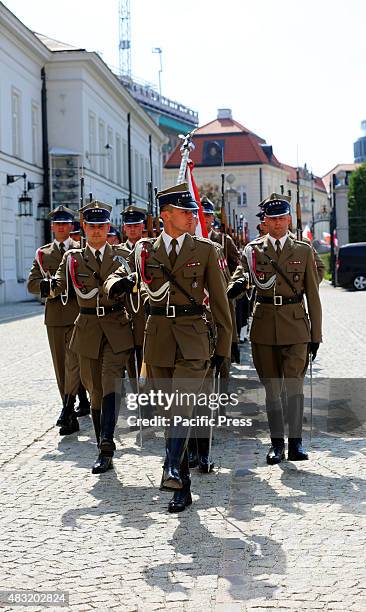

Poland has poured roughly 2,000 land‑force soldiers into Warsaw, turning the capital into a forward‑defence showcase at a moment when NATO’s eastern flank feels the pressure of Russian posturing and a volatile high‑north security environment. The swift redeployment, announced in mid‑January, was presented by Warsaw as a concrete expression of alliance solidarity, yet the legal instrument that authorised the move remains hidden from the public record.
Searches of the Ministry of Defence’s portal, parliamentary bulletins and the Polish Press Agency yielded no decree, council resolution or presidential order that could be cited as the formal basis for the operation. Analysts therefore treat the manoeuvre as an executive decision taken under an internal defence‑policy framework that does not require public publication, leaving a transparency gap that will fuel scrutiny from both allies and domestic watchdogs.
Defence Minister Władysław Kosiniak‑Kamysz used a 16 January press briefing to cast the troop influx as a “bridge” that links NATO partners and safeguards the alliance’s collective security. He stressed that “Poland wants to keep the unity of the Alliance, and what is important for that is cooperation with allies, led by the United States.” The minister’s rhetoric placed the United States at the heart of NATO’s deterrent power and framed Warsaw’s soldiers as a tangible contribution to that shared strength.
Two days earlier, Foreign Minister Radosław Sikorski broadened the narrative, tying the Warsaw deployment to a wider deterrence posture that stretches from the Suwałki Gap to Greenland. He reminded listeners that about 150 U.S. troops are already stationed on the Arctic island and warned that any Russian or Chinese move against Greenland could trigger NATO‑organised exercises. By invoking the 1973 Turkish invasion of Cyprus, Sikorski suggested that internal disputes need not cripple the alliance if member states stand together.
Prime Minister Donald Tusk, speaking on 15 January, added a decisive note by ruling out any Polish contribution to a potential Greenland deployment. He warned that any attempt by a NATO member to seize part of another ally would be “a political disaster” and “the end of the world as we know it.” While not directly referencing the Warsaw troops, his statement reinforced a narrative of defending NATO’s territorial integrity against unilateral actions.
NATO’s own multimedia release echoed Warsaw’s messaging, positioning the reinforcement within the Enhanced Forward Presence and underscoring the strategic importance of the Suwałki Gap. Lithuania responded most visibly: defence minister Robertas Kaunas met Kosiniak‑Kamysz on 16 January and hailed the “particularly strong partnership” and the joint development of the Kapčiamiestis training area as a boost to the corridor that links the Baltic states with the alliance’s core. Estonia and Latvia offered no public comment in the sources examined, nor did the Balkan NATO members Slovenia, Croatia or Montenegro, suggesting either a muted diplomatic response or a delay in formal statements.
The episode must be read against a backdrop of three interlocking security dynamics. First, the Suwałki Gap remains NATO’s most vulnerable land bridge to the Baltic states, and Warsaw’s troops are a direct reinforcement of that chokepoint. Second, the United States’ high‑north footprint, highlighted by the Greenland contingent, signals a willingness to extend deterrence beyond the eastern flank. Third, the consistent emphasis on “jedność NATO” across Warsaw’s senior officials reflects a strategic calculus that the alliance’s cohesion is the decisive factor in deterring aggression from Russia or China.
In short, the January redeployment is less an isolated Polish escalation than a calibrated signal to both allies and adversaries: Poland is ready to mobilise domestically to buttress collective defence, to operate under NATO’s deterrence architecture, and to coordinate closely with the United States and neighbouring partners. The lack of a publicly disclosed legal decree, however, underscores the need for greater transparency if the alliance is to maintain credibility and unity in an increasingly contested security landscape.
Image Source: www.gettyimages.com