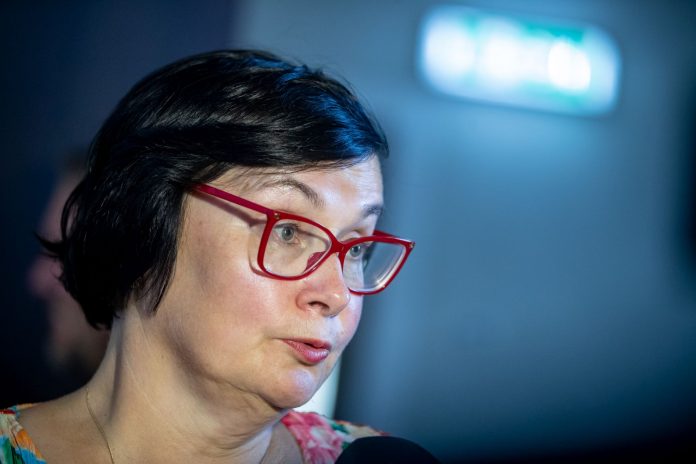

Katri Raik has been re‑elected mayor of Narva by a razor‑thin 16‑15 council vote, cementing her grip on Estonia’s most exposed frontier city on 16 December 2025. The former interior minister’s return to the mayoral desk comes with a 94‑point coalition programme that promises to turn a city where 41 % of residents live in absolute poverty into a linchpin of EU‑backed industry and NATO deterrence.
The election was the climax of a fractured local poll in which Mihhail Stalnuhhin’s “Rahvanimekiri” list won 12 seats, the Centre Party 10, Raik’s own list five and a small “Plaan B + Narva Pulss” alliance four. Raik, who has already served three separate mayoral spells (2020‑21, 2021‑23 and 2024‑25) and was council speaker in 2021, secured the mayoralty by a single vote after intense behind‑the‑scenes bargaining over a stable, long‑lasting coalition. The new city government will be finalised by the turn of the year.
At the heart of Raik’s agenda are three interlinked strands: a social‑welfare push to halve the city’s poverty rate, a hard‑nosed infrastructure drive, and a security overhaul. The platform calls for accelerated district‑heating upgrades, a rapid “order in district heating”, and a concerted effort to “create jobs” by deepening cooperation between local firms. On the cultural front she refused to hand over the Russian‑art museum collection to the Estonian state, signalling a desire to keep heritage assets under Narva’s control. Most strikingly, she endorsed the establishment of a permanent NATO‑linked military base – “logically” required given that Russian positions lie a few hundred metres from the town hall – and publicly lambasted the sealed Narva‑Ivangorod vehicular bridge as a barrier to stability.
The security implications are immediate. A permanent NATO presence, slated to host several hundred soldiers, will embed Estonia’s Enhanced Forward Presence directly in the city’s fabric, tightening the frontier’s deterrence but also hardening Tallinn’s diplomatic exchanges with Moscow. Russian analysts are already framing the base as a direct challenge, while the “dragon’s teeth” concrete barriers and limited pedestrian access on the Friendship Bridge underscore a militarised border that complicates any attempt to revive cross‑border traffic. Yet the decision to retain the Russian‑art collection offers a modest soft‑power channel that could be expanded into joint exhibitions or cultural exchanges, potentially easing people‑to‑people tensions if both sides are willing.
Narva’s agenda dovetails neatly with existing EU border‑region financing. The Interreg VI programme and the Cohesion Fund can co‑finance up to 80 % of projects that improve connectivity, energy efficiency and regional resilience – exactly the kind of upgrades Raik’s platform demands. The €1.73 million AccelerateGDT cluster project, running 2023‑27, already targets SME competitiveness, green and digital transitions, and could be leveraged for district‑heating and industrial cluster development. Moreover, the €18.7 million EU grant that underpins the Neo rare‑earth magnet plant – a facility now supplying roughly 10 % of EU demand – provides a concrete anchor for future EU‑backed supply‑chain diversification and high‑tech manufacturing. However, no formal application for Interreg or CEF funding has yet been published, meaning the municipality must move quickly to translate policy promises into funded proposals.
Reactions from the wider geopolitical arena are predictable but significant. Kyiv, which has repeatedly pressed for a stronger NATO footprint on its eastern flank, is likely to welcome the permanent base as a bulwark against further Russian aggression. Moscow, by contrast, has already signalled that the deployment will be perceived as a “direct challenge”, warning of a hardening security dialogue. The EU, meanwhile, has praised Narva’s thematic alignment with its cross‑border, green‑digital and industrial strategies, viewing the city as a test case for how frontier regions can combine resilience with economic renewal. EU officials have hinted that successful implementation could unlock further “nearly four‑times‑larger” CEF funding for transport and energy links after 2028.
If the programme materialises, the economic outlook could shift dramatically. Reliable district heating would lower industrial operating costs, encouraging foreign direct investment and supporting the scaling of the Neo plant from 2 000 t to a projected 5 000 t of rare‑earth magnets, with ambitions of reaching 20 000 t. The attendant job creation could pull the poverty rate well below the current 41 % level, while a revived cultural‑tourism offering centred on the Russian‑art collection would generate service‑sector income – provided the vehicular bridge is eventually reopened under coordinated security protocols.
Raik’s second term is therefore a high‑stakes balancing act: deterrence through a NATO foothold, economic revival via EU‑backed industry, and cultural stewardship to keep the city’s Russian‑speaking majority engaged. The coming months will reveal whether Narva can convert a hard‑line security posture into a catalyst for prosperity, or whether the city will become another flashpoint in the fragile East‑West fault line that runs along the Friendship Bridge.
Image Source: bnn-news.com