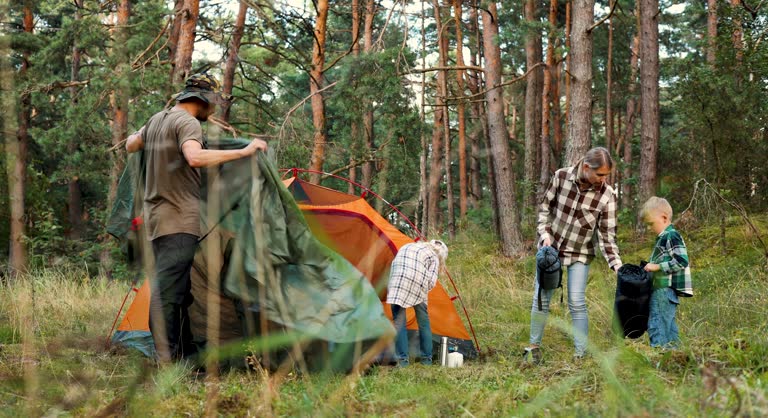

ForCamping has smashed the €1 billion market‑value ceiling, a milestone that instantly re‑writes the map of Central Europe’s outdoor‑goods sector. The Czech chain’s meteoric rise is being read as a bellwether for a new wave of “stay‑cation” spending, where middle‑class families channel disposable income into camping, hiking and adventure sports rather than overseas holidays.
The company’s growth story is built on a decisive reshuffle of its product DNA. Once a specialist in tents, sleeping bags and pads, those core items now account for only about a fifth of ForCamping’s catalogue. Today, high‑margin clothing has become the top‑selling segment, while climbing equipment posts the strongest ancillary growth. Private‑label brands such as Warg, Zulu and Mooa, together with the recent acquisition of Sport Schwarzkopf and its High Point line, give the chain a foothold in the fast‑moving backpack market – which commands 28.12 % of European sales – and the burgeoning camping‑furniture sector, projected to expand at a 7.76 % CAGR through 2031.
The macro backdrop is equally compelling. Global camping‑equipment sales climbed from USD 20.85 billion in 2024 to USD 22.08 billion in 2025 and are set to hit USD 29.49 billion by 2031, implying a 5.92 % compound annual growth rate. Offline sales still dominate at 67.45 % of the market, but e‑commerce is accelerating at an 8.16 % CAGR, adding a further 1.3 % to overall market expansion. These figures underline a fertile environment for ForCamping’s product‑mix pivot and its ambitious expansion plan.
At the heart of that plan lies a CZK 150 million investment in warehouse‑logistics automation, slated for completion by the end of 2026. An autonomous packing line will shrink box dimensions by up to 15 %, allowing more units per truck and slashing per‑unit freight costs on the long‑haul corridors that feed Poland, Slovakia, Hungary and Romania. The chain continues to operate a single, centrally located hub in Pardubice, from which roughly 30 stores across five countries are supplied. A new outlet opening in Košice in February 2026 signals that the hub‑and‑spoke model will persist, even as the logistics upgrade forces regional carriers to adapt to higher load‑factors and more streamlined handling.
Industry analysts warn that the ripple effects will be felt hardest by small‑scale retailers. ForCamping’s economies of scale and 15 % packaging efficiency enable it to undercut independent shops on price while protecting margins, squeezing the profitability of traders who lack comparable freight leverage. The ongoing digital shift compounds the pressure: online sales are growing faster than brick‑and‑mortar, and smaller operators must now invest in robust e‑commerce platforms, click‑and‑collect services or marketplace partnerships to stay relevant. The sector’s low concentration masks an emerging consolidation wave, exemplified by ForCamping’s takeover of Sport Schwarzkopf, which could see niche specialists either absorbed or crowded out as the chain broadens its apparel and climbing‑gear range.
Tariff‑related cost spikes add another layer of difficulty for independents, who lack the bargaining power to secure favourable import terms. As larger players re‑engineer sourcing and pass savings on to consumers, small retailers face a widening cost gap that threatens inventory stability. Moreover, the market’s tilt toward high‑margin clothing and climbing equipment forces traditional camping‑gear shops to diversify their assortments, a move that demands new supplier relationships and higher capital outlay.
In sum, ForCamping’s €1 billion valuation is not merely a corporate triumph; it is a catalyst reshaping the Central European outdoor‑retail ecosystem. By marrying an aggressive product‑mix transformation with cutting‑edge logistics and a pan‑regional store network, the chain is setting new cost and service benchmarks that will compress prices, accelerate digital adoption and spur further consolidation. For the myriad independent retailers scattered across the Czech Republic, Slovakia, Poland and Hungary, the message is clear: adapt quickly, embrace omnichannel strategies and carve out niche expertise, or risk being left behind in the wake of the outdoor boom.
Image Source: www.istockphoto.com