
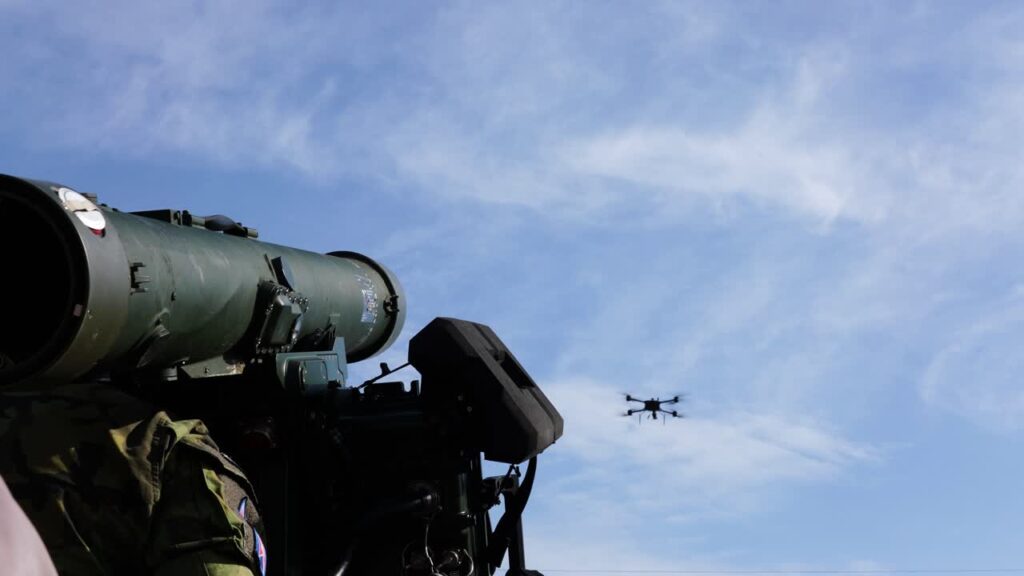

Croatia has thrown €125 million into a home‑grown anti‑drone shield, a move that turns the country from a peripheral NATO member into a regional hub for low‑altitude air defence. The programme, signed in late 2025, will see four sophisticated C‑UAS systems – two fixed installations protecting critical sites and two mobile units for a medium‑infantry brigade – fully operational by 2027.
The catalyst was a wave of unauthorised UAV flights that swept across the EU and NATO space in April 2024, first spotted over the Baltic Sea and quickly echoing through Poland, Italy and Greece. While no Croatian facility was directly hit, security officials warned that the “frequent intrusions of Russian drones” exposed a glaring vulnerability in the nation’s critical infrastructure. Deputy Prime Minister and Defence Minister Ivan Anušić told reporters in Zagreb that the procurement was a “necessary response to an evolving threat that can bypass traditional radar and air‑defence layers”.
Under the €125 million framework, Končar‑Digital d.o.o. will act as system integrator, assembling a suite that blends early‑warning radars, an AI‑driven operations centre, kinetic 30 mm anti‑drone cannons and electronic interceptors. The core of the hardware – the SKYctrl system originally developed by Poland’s Advanced Protection Systems – will be transferred to Croatian factories, with domestic AI modules supplied by Osijek‑based Orqa. “We are building not just a shield but a sustainable industrial capability,” said a senior Končar‑Digital engineer, who asked to remain unnamed for security reasons.
The timeline is now crystal clear. After the April 2024 drone wave, the Ministry of Defence launched a threat assessment in early 2025, culminating in the approval of the five‑year framework in the second half of the year. Delivery is staged: the first fixed installation is slated for early 2026, followed by the second later that year, with the mobile units arriving in 2027. This phased rollout allows seamless integration with Croatia’s existing air‑defence network and the NATO Integrated Air and Missile Defence System (NATINAMDS) centred in Torrejon, Spain.
NATO’s C‑UAS coordination cell will receive real‑time data from Croatia’s new operations centre, expanding the Alliance’s low‑altitude detection envelope along the Adriatic flank. A NATO liaison officer, speaking on condition of anonymity, confirmed that the mobile units will be earmarked for forward‑deployed NATO forces, bolstering “Eastern Sentry” missions that now explicitly include drone‑countering capabilities. By contributing a dedicated anti‑drone layer, Croatia eases the defensive burden on its neighbours and reinforces the Alliance’s collective resilience.
Beyond the strategic calculus, the deal signals a shift in Balkan defence procurement toward indigenous, Western‑standard technology. Minister Anušić highlighted that Croatia now stands “alongside the Netherlands and Latvia as a leading EU producer of FPV drones”, positioning the country to feed both NATO and EU “anti‑drone wall” initiatives. The programme’s €115 million domestic allocation underscores a commitment to burden‑sharing, creating a European‑wide industrial base that can sustain, upgrade and potentially export the technology to other allies.
In short, the anti‑drone programme translates a reactive security scare into a forward‑looking capability that protects power plants, ports and military bases, while weaving Croatia tighter into NATO’s air‑defence fabric. If the delivery schedule holds, the country will field a fully integrated C‑UAS network by 2027 – a tangible answer to the drone swarms that rattled Europe two years ago and a blueprint for other small NATO members facing the same low‑altitude menace.
Image Source: www.videvo.net