
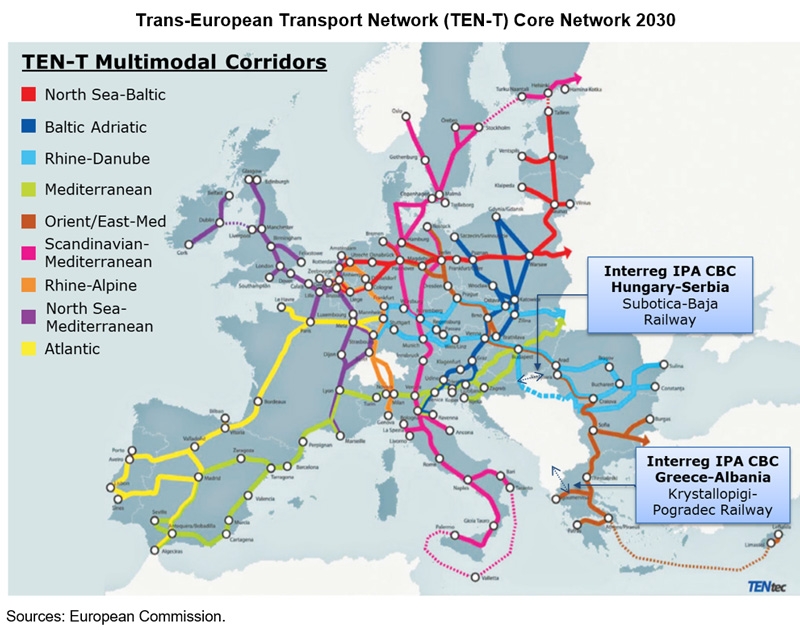

The EU is finally turning talk into steel and spectrum, with a cascade of rail‑border upgrades and cross‑border 5G corridors set to stitch the Western Balkans, Central Europe and the Baltic states into a single, high‑speed economic artery. In less than two years the Tabanovce railway station on the North‑Macedonia‑Serbia frontier will morph from a rundown checkpoint into a one‑stop‑shop for customs, immigration and train operations, while three 5G corridors – from Bulgaria to Serbia, Poland to the Czech Republic and Northern Ireland to Rosslare – will light up the region with ultra‑low‑latency connectivity.
The rail component centres on the Pan‑European Corridor X, Europe’s historic east‑west trade route. The flagship Tabanovce joint border station is funded by a €2.8 million EU grant through the Western Balkans Investment Framework and a €5 million European Bank for Reconstruction and Development loan, totalling €7.65 million for construction, supervision and new photovoltaic‑equipped buildings. The upgrade includes ETCS‑compatible signalling, modernised customs facilities and a shared immigration desk designed to slash processing times for both freight and passengers. It is the first concrete step in a broader, albeit less‑quantified, modernisation of the North‑Macedonia–Serbia stretch of Corridor X, which aims to lift line capacity from two‑to‑three trains per hour to six‑to‑eight.
On the digital front, the European Commission’s December 2023 CEF‑Digital decision earmarked €10.6 million for three fully funded cross‑border 5G projects. The €3.36 million “5G BALKANS” corridor will link Bulgaria and Serbia, the €2.06 million “BALTCOR5G” will join Poland and the Czech Republic, and the €5.21 million “IrishSea5GCOR” will connect Northern Ireland with Rosslare Harbour. A further €1.37 million under the Horizon 2020 5G‑PPP “5G‑ROUTES” initiative supports field trials along the Via Baltica‑North corridor, testing more than 150 network and service KPIs across rail, road and maritime use cases. While exact start‑up dates are not disclosed, the 5G projects are slated for deployment during 2024‑2025, with the Via Baltica trials running through 2026 and commercial roll‑out expected thereafter.
Funding for these ventures is a blend of EU grants, multilateral loans and national co‑financing. The Tabanovce station’s €2.8 million grant sits alongside a €5 million EBRD loan, both already disbursed, with construction scheduled to begin in 2025 and an operational horizon of 2027‑2028. The broader Corridor X upgrade is anchored by a €7.5 million joint EU‑EBRD investment for the border component, while the remaining works will likely stretch across a 2025‑2030 window, typical for regional rail programmes. The 5G corridors rely on EU grant money as the seed, with national governments expected to fill the balance, and the Horizon‑funded 5G‑ROUTES project combines €1.37 million of EU support with €1.59 million from industry partners.
Although the source material does not provide hard freight‑tonnage or commuter‑flow forecasts, the strategic narrative is clear: faster, single‑window customs at Tabanovce will cut dwell times for freight trains, making rail a more attractive alternative to road haulage and boosting the share of intra‑regional cargo moving between the Balkans, Vienna, Prague and Baltic ports. The upgraded signalling and higher line capacity will accommodate up to eight trains per hour, opening the corridor to bulk commodities, automotive components and time‑critical goods. Meanwhile, the 5G backbones will enable real‑time traffic management, predictive maintenance and V2X‑enabled freight convoys, slashing logistics costs and sharpening supply‑chain resilience.
For workers, the impact is equally tangible. Streamlined passenger checks at the modernised border will facilitate daily and weekly commuting for skilled staff in logistics, manufacturing and ICT, while the ultra‑reliable 5G links will support remote‑working platforms, cross‑border e‑learning and digital‑skill exchanges, effectively widening the European labour market beyond national borders. The EU’s own corridor literature stresses that smoother border procedures and digital services are essential levers for expanding labour mobility, and these projects deliver exactly that.
In sum, the EU’s latest wave of rail and digital infrastructure funding marks a decisive move from blueprint to build‑out. With construction kicking off in 2025 and 5G deployments already underway, the Western Balkans, Central Europe and the Baltic states are poised to become a tightly knit economic zone where goods glide faster and data flows freer, laying the groundwork for a more integrated, competitive Europe.
Image Source: research.hktdc.com