
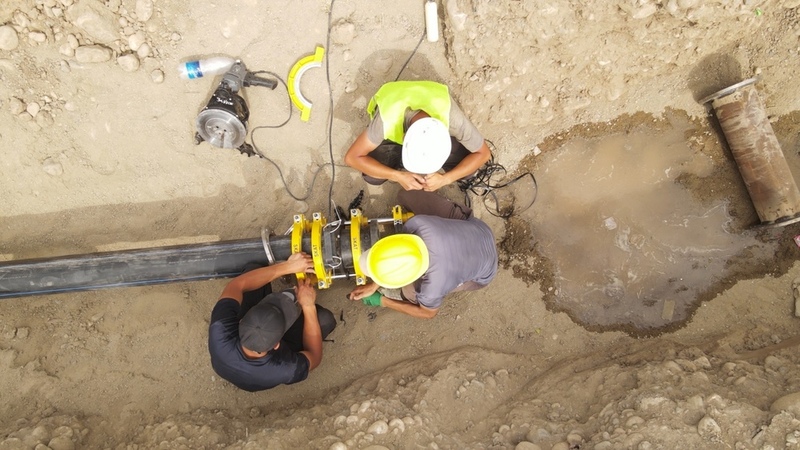

The capital’s 12‑microdistrict will be plunged into silence on 20 January as Bishkekvodokanal suspends drinking‑water service for an “extended period”, leaving homes, schools, preschools and health‑care facilities to fend for themselves. The municipal notice offered no technical explanation, merely urging residents to “store drinking water in advance”. In a city where emergency repairs have become routine, the latest cut is a stark reminder that Bishkek’s water supply is teetering on the brink.
The pattern is familiar. In late December 2025 a city‑wide shutdown was triggered by emergency work on a 1 000‑millimetre‑diameter pipeline, curtailing supply from 10 a.m. to midnight in the Archa‑Beshik and Selektsiya districts. A similar interruption on 20 November 2025 was blamed on repairs at the “Kok‑Jar” intake, while a November 2024 outage in microdistrict 5 resulted from damage to a privately owned pipeline. Each incident has unfolded without coordinated water‑truck deliveries or temporary storage tanks, forcing the burden of coping onto individual households.
The underlying causes run deeper than isolated pipe failures. Bishkek’s distribution network, built during the Soviet era, draws water from 37 irrigation intakes on the Orto‑Alysh and Ala‑Archa deposits. The Orto‑Alysh intake alone supplies over 40 % of the city’s demand, yet engineers report a chronic shortfall of roughly 1 000 m³ per hour and groundwater levels 15‑20 metres lower than a year earlier. Frequent leakages and pressure drops are now the norm, prompting the utility to resort to ad‑hoc shutdowns for emergency repairs.
Compounding the ageing infrastructure is a dwindling natural reservoir. The Chui River, fed predominantly by glacier melt, has seen its source shrink by more than 16 % over the past fifty years. Deputy Minister Almaz Musaev has warned that glaciers act as “important reservoirs of fresh water”, yet reduced meltwater and low precipitation this winter thwarted a contract to refill the Orto‑Alysh intake with 11 million m³ of water. The shortfall underscores how climate‑driven supply stress is now inseparable from the city’s chronic under‑investment.
Short‑term response has been limited to a public advisory to store water, echoing the same approach taken during the December 2025 pipeline repair. No organized emergency logistics—such as water‑truck fleets or rationing schemes—have been announced, leaving vulnerable groups, especially the elderly and patients in health‑care facilities, exposed to prolonged deprivation. The reliance on personal storage highlights a glaring gap in municipal emergency preparedness.
Looking ahead, experts stress that piecemeal repairs will not suffice. A “substantial renovation” of the distribution network is repeatedly called for, including pipe replacement, pressure‑regulation upgrades and the rollout of smart‑metering to curb the estimated 1 000 m³ per hour loss. Expanding storage capacity, whether through new reservoirs or enlarged tanks, is also on the agenda, though its success hinges on restoring reliable glacier melt and precipitation flows. At the 2026 “Water, Mountains and Glaciers of the Kyrgyz Republic” conference, policymakers advocated for integrated basin management, improved glacier monitoring and demand‑management campaigns to curb domestic over‑consumption.
Ultimately, the 20 January outage is a symptom of systemic fragility rather than an isolated glitch. To avert a repeat of such disruptions, Kyrgyzstan will need to marshal financing, strengthen institutional capacity and accelerate network upgrades before the next winter freeze or summer heatwave pushes the water system past its breaking point. Only a coordinated, climate‑resilient strategy can guarantee uninterrupted access to the most basic of services for Bishkek’s residents.
Image Source: akipress.com