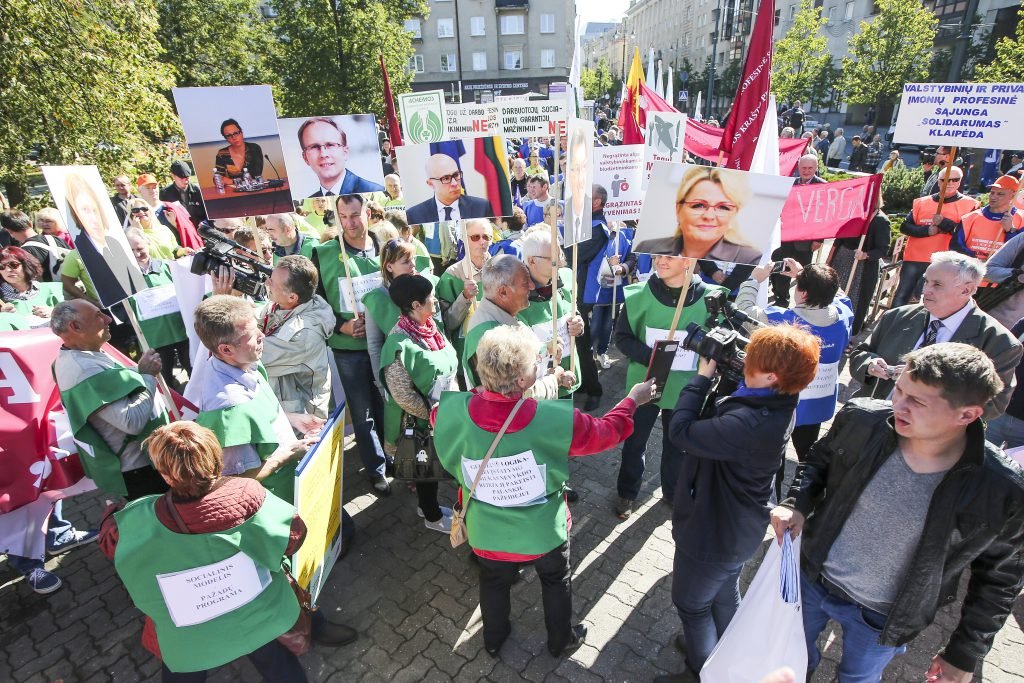

Mass in Vilnius has turned the capital into a crucible of democratic fury, with more than ten thousand Lithuanians taking to the streets between 11 and 17 December to stop a government‑backed overhaul of the public broadcaster LRT that many fear will turn the state’s own media into a mouthpiece for the ruling coalition.
The protests, which surged to a peak of roughly ten thousand on 17 December, were not a spontaneous outburst but the culmination of a highly coordinated civil‑society campaign that saw a petition signed by 143 000 citizens—making it the most popular online petition in Lithuanian history. Demonstrators, marching outside the Seimas, chanted that the amendments would allow successive governments to censor journalists and editors or force them to self‑censor, effectively eroding LRT’s editorial independence and, by extension, the very fabric of free speech in the country.
Statistically, the turnout is striking. A single day’s gathering of ten thousand people in a city of 580 000 is a clear signal that the issue has struck a national nerve. The petition’s 143 000 signatures represent about a quarter of the adult electorate, underscoring the depth of public concern. Compared with past civic mobilisations, such as the 2017 protests over pension reform, the scale and speed of this mobilisation—spanning just a week—illustrate a newfound organisational capacity among grassroots networks, amplified by social‑media coordination and a shared narrative of democratic erosion.
Politically, the driver is the governing coalition’s package of amendments to the LRT governance structure. The council, currently composed of four presidential appointees, four parliamentary appointees (split evenly between governing and opposition parties), and four civil‑society members, would have its threshold for removing the director‑general lowered from a two‑thirds majority to a simple majority of seven out of twelve seats, with the process moved to a secret ballot and broadened grounds for dismissal. In effect, the reforms would tilt the balance in favour of politically aligned members, giving the coalition a direct route to influence editorial content and undermining the broadcaster’s role as a neutral public service.
EU‑level experts warn that this domestic backsliding could trigger a broader reckoning. The European Media Freedom Act, adopted in August 2025, contains Articles 5 and 6 that mandate the independence of public broadcasters and protect editorial autonomy—precisely the safeguards the protests are demanding. The Act also establishes a European Board for Media Services that could monitor any changes to LRT’s governance and impose sanctions if the amendments contravene EU law. Should the Commission decide to intervene, it could issue a formal notice, request a review of the amendments, or even bring the case before the European Court of Justice, signalling that the EU will not tolerate attempts to politicise its member‑states’ media institutions.
The protests are rooted in a longer historical arc that began with Lithuania’s independence in 1990 and the sweeping post‑Soviet reforms aimed at aligning the country with EU norms. Health‑care, education, pensions, and labour reforms ushered in market‑oriented structures but also triggered economic hardship and a perception that the state’s social contract was weakening. The erosion of trust in institutions, compounded by the present political manoeuvres, has created a climate where civic mobilisation is not just possible but inevitable.
Beyond the immediate clash over LRT, the Vilnius demonstrations could prompt the EU to strengthen its democratic‑backsliding monitoring framework. By integrating media governance metrics into its assessment tools, the European Parliament could send a clear message that editorial independence is a core pillar of democratic health. The potential for the European Board for Media Services to act as a watchdog over member‑state broadcasting reforms could deter future attempts to politicise public media, thereby reinforcing the EU’s commitment to democratic standards across the bloc.
In sum, the mass protests in Vilnius are more than a domestic spat over a broadcaster’s charter; they are a bell‑wether for the health of liberal democracy in the region. If the European Commission follows through on the safeguards enshrined in the Media Freedom Act, it could set a precedent that ensures that media independence is not merely a national right but a protected European value—one that citizens across the Union will be watching closely.
Image Source: lithuaniatribune.com