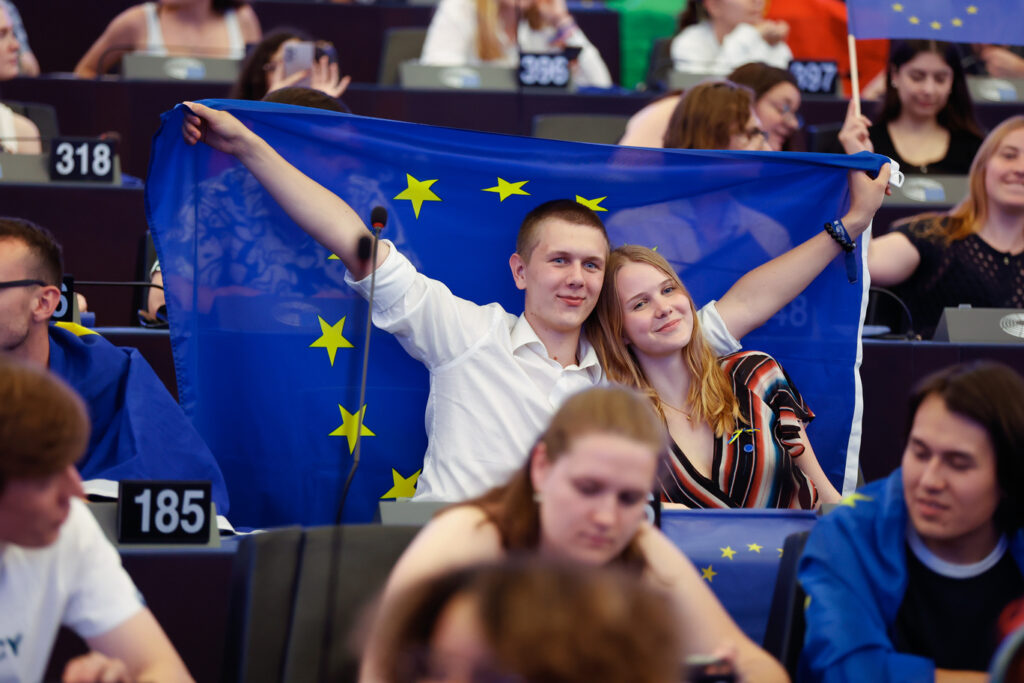

A sharp new poll has sent a resounding message into the heart of Brussels: two‑thirds of Europe’s 18‑ to 29‑year‑olds want a more powerful Union. The December 2025 survey, which canvassed the continent’s youth, found that 62 % are in favour of a stronger EU, a figure that eclipses any previous generation’s enthusiasm for integration. The data is not a mere curiosity; it is a clarion call that the next wave of Europeans will not be content with the status quo.
The pulse of that enthusiasm is rooted in three inseparable drivers. First, digital inclusion is no longer a niche concern but a core value. An EAfA monitoring survey recorded that 85 % of young respondents view digital progress positively, and the EU’s own investment in over two million apprenticeship places – including 143 000 in STEM and 402 000 earmarked for women – demonstrates that youth see a powerful Union as a gateway to skills and careers that cross borders. Erasmus+ has already moved 119 000 young people across the continent in 2024‑25, turning the EU into a single market for talent and ideas.
Second, economic uncertainty has sharpened the urgency of integration. The European Central Bank’s financial stability review of November 2025 warned of a volatile international environment, strained public finances and the risk of sudden market shifts. For a generation still finding its footing, the prospect of coordinated fiscal policy and a unified monetary framework is not abstract policy but a lifeline. The Economic Policy Uncertainty Index confirms that young Europeans are keenly aware of macro‑economic volatility and view a stronger EU as a stabilising force that can smooth the distribution of resources across member states.
Third, migration patterns underscore the need for solidarity and coherent governance. The 2025 Migration Advisory Committee report stresses that intra‑EU flows remain significant, with cross‑border movement driving youth employment and cultural exchange. The EU’s ability to manage migration in a way that balances labour‑market needs with social cohesion is, for many young people, a litmus test of the Union’s commitment to shared responsibility.
Experts echo this sentiment. Digital inclusion guidelines published by the European Commission in April 2024 raise alarms about privacy, mass surveillance and algorithmic bias, insisting that human rights must be central to Europe’s digital future. Youth activists have taken up this challenge, gathering in Tirana in November 2025 to draft a Youth Perspective for COP30, a workshop organised by UNESCO and EDEN that brought 25 international young activists from nine countries together. The workshop highlighted barriers to participation – from financial constraints to entrenched seniority cultures – and underscored the necessity of an EU framework that amplifies young voices in climate and technology policy.
A shining example of youth-led EU initiative is the Erasmus+ mobility programme itself. By facilitating 119,000 mobility experiences in 2024‑25, it has created a “single market for young talent” that reduces national barriers and fosters a sense of belonging beyond borders. Participants report that the experience not only enhances their employability but also deepens their commitment to a pan‑European identity, reinforcing the idea that a stronger Union is essential for real, tangible opportunities.
Policymakers now face a clear mandate. The youth’s call is not a fleeting trend but a strategic response to digital, economic and social challenges that define their generation. Brussels must translate this mandate into concrete reforms: investing in digital infrastructure that is inclusive and rights‑based; expanding mobility and apprenticeship schemes; coordinating fiscal and monetary policy to mitigate shocks; and crafting a coherent migration strategy that reflects shared responsibility. The future of EU integration hinges on the Union’s ability to respond with tangible, inclusive, forward‑looking action, lest it risk losing the very generation that will carry its legacy forward.
Image Source: european-youth-event.europarl.europa.eu