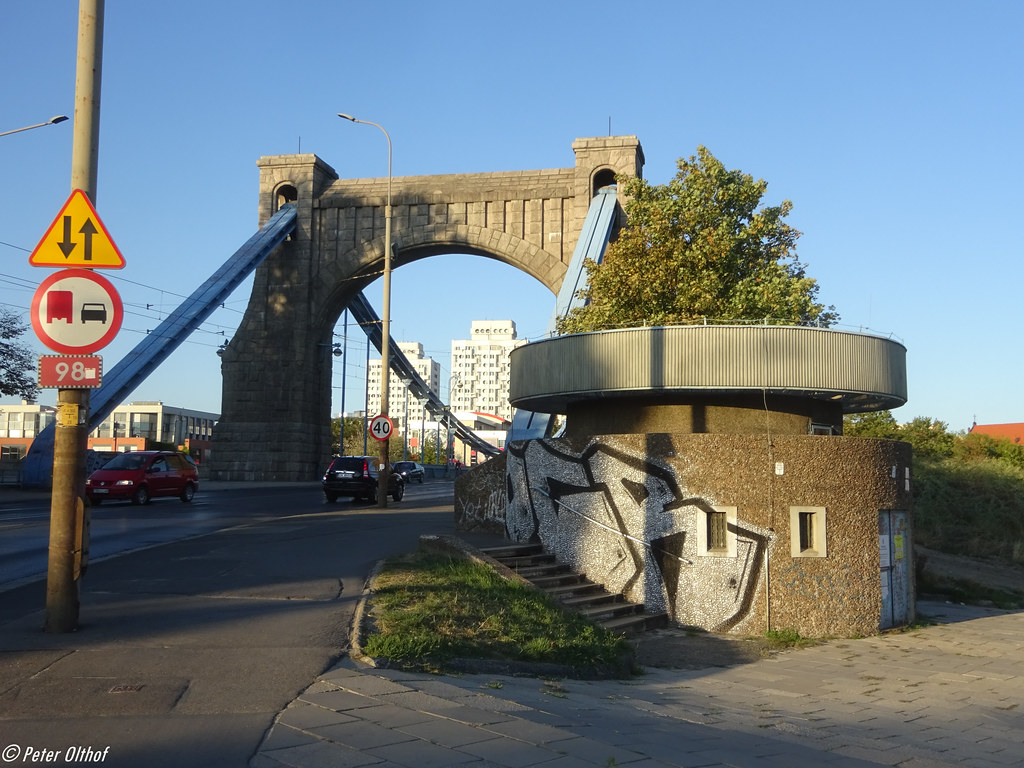

The Oder River bridge is finally rising from the ashes of a derelict 1926 span, and with a €181 million price tag it promises to stitch together Poland’s industrial heartland and Germany’s bustling ports in a single, high‑speed freight artery. For Silesia – a region that pumped out €150 billion of GDP in 2022 – the new crossing could be the catalyst that turns endless road queues into sleek, rail‑borne supply chains. In an era where European logistics are scrambling for resilience, this carbon‑fiber‑reinforced marvel arrives like a bolt of engineering audacity.
The structure replaces the crumbling historic bridge with a 266‑metre network‑arch, its 130‑metre main span supported by 88 carbon‑fiber‑reinforced polymer tension members – a world‑first for a railway bridge of this class. At 13 metres wide and built for double‑track heavy‑rail freight, the bridge can host trains travelling up to 120 km h⁻¹, a stark upgrade from the speed‑restricted, ageing crossing that was shut to rail traffic in 2022. By shedding roughly 500 tonnes of steel and 1 350 tonnes of concrete, the design not only trims dead weight but also lowers axle loads, paving the way for longer, heavier trains.
From a logistics standpoint the bridge re‑establishes a direct rail conduit between the Silesian belt and the German network that feeds Hamburg, Bremen and the wider North‑Sea hub. The double‑track layout and higher design speed should dramatically boost line capacity, offering a viable alternative to the €9.7 billion of annual truck tolls recorded at Polish‑German checkpoints. While the agencies have yet to publish hard traffic forecasts, the technical specifications make clear that the corridor can now accommodate the heavier axle loads demanded by modern freight, a prerequisite for shifting a meaningful share of cross‑border cargo from road to rail.
Curiously, the financial anatomy of the €181 million project remains shrouded in silence. No official breakdown has been released, leaving the split between EU cohesion funds, Polish and German national or regional budgets, and any private‑sector participation a mystery. By contrast, a related €37 million bridge at the same crossing, completed in July 2024, was funded jointly by the German federal and state governments, suggesting a similar binational cost‑sharing model could be in play – but without concrete figures, risk allocation and long‑term maintenance responsibilities cannot be assessed.
The economic stakes are undeniable. Silesia’s eight‑million‑strong population and its €150 billion output sit alongside a Poland‑Germany trade surge that hit €90 billion in the first half of 2025, with German exports to Poland alone reaching €49.4 billion. Restoring the rail link promises lower transport costs for heavy‑industry manufacturers, faster access to Northern European markets, and a potential reduction in road congestion that could benefit both sides of the border. Environmental gains are also on the cards: the carbon‑fiber construction trims the bridge’s embodied carbon, and the envisaged modal shift aligns with the EU’s target of cutting road freight on key corridors by 30 % by 2030.
Nevertheless, the public record is thin on the quantitative impact. No official forecasts exist for annual train movements, freight‑ton‑kilometre gains, travel‑time savings, or the precise GDP uplift the bridge might generate. Likewise, the financing mix, the timeline for complementary upgrades on the Kostrzyn–Wrocław and Küstrin‑Kietz–Berlin–Hamburg lines, and the standards for signalling interoperability remain undocumented. Without these data, analysts can only infer potential benefits from comparable EU cross‑border projects, which have historically delivered modest GDP bumps and 5‑10 % freight‑cost reductions.
In short, the Oder River bridge is an engineering triumph poised to revive a once‑vital Silesian corridor, but its true value will only emerge when the opaque financing details are disclosed and rigorous traffic and economic impact studies are published. Until then, policymakers, investors and the business community must watch closely, hoping that the promise of faster, greener freight will translate into measurable growth for a region that has long deserved a modern, reliable link to the heart of Europe.
Image Source: www.flickr.com