
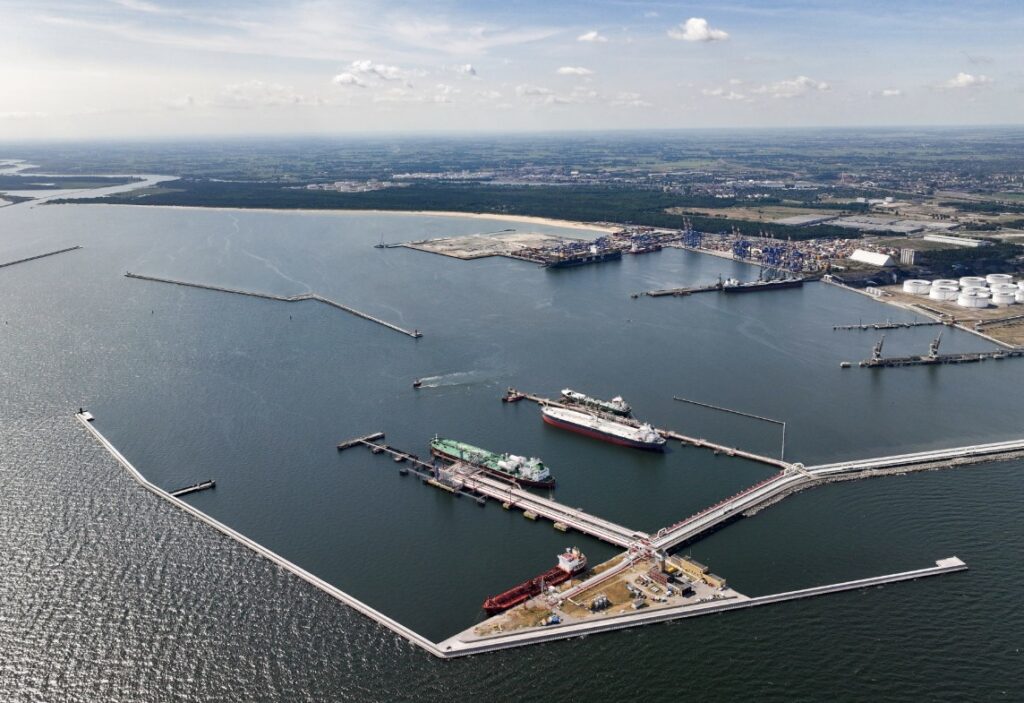

The decision to shut down Gdańsk’s deep‑water Port Północny has sent shockwaves through the Baltic freight community, and the signal could not have been clearer: Poland is abandoning the only ultra‑large‑vessel berth in the sea to chase a greener, rail‑centric future. Within weeks the terminal, which only last year celebrated the installation of its final three ship‑to‑shore cranes, will be stripped of its moorings, leaving the region’s cargo map irrevocably redrawn.
Port officials have framed the closure as a strategic pivot, not a retreat. In 2024 the Port of Gdańsk posted a net profit of roughly 264 million zł and handled 77.4 million tonnes of cargo, with container volumes up around ten percent and average vessel size climbing to 25 025 gross tonnes. Yet the same report shows the authority diverting capital from costly dredging and berth reinforcement toward expanding the Baltic Hub’s rail capacity, now targeting more than 800 000 TEU a year with a one‑million‑TEU ambition by 2027.
The economics are stark. Deep‑water upgrades demand multi‑hundred‑million‑zł outlays for dredging, reinforced quays and additional cranes, while the return on such investment is eroding as German rivals—Rostock and Lübeck—have already secured the deep‑water niche. By locking in a 2024 rail‑access agreement with PKP Polskie Linie Kolejowe, Gdańsk guarantees dedicated slots for freight moving inland, effectively bypassing the sea leg that the Północny terminal was built to serve. The calculus favours rail’s higher ROI and Poland’s geographical advantage in connecting the Baltic to Central Europe.
Environmental imperatives sharpen the picture. The Baltic Hub cut its greenhouse‑gas intensity by 8.47 % in 2024, dropping from 7.2 kg CO₂e per physical TEU to 6.59 kg, and now draws 100 % of its power from renewable sources. Waste handling also improved, with 89 % of the 640 889 kg generated being recycled or recovered. Avoiding the continual dredging required to keep a deep‑water berth operational dovetails with the EU Green Deal’s decarbonisation targets, positioning the hub as a low‑carbon logistics node that can claim genuine emission reductions rather than cosmetic offsets.
Freight is already rerouting. Container traffic that once relied on Północny’s deep‑draft capacity is being funneled into the Baltic Hub and other Polish terminals equipped for seamless rail transfer, accelerating the modal shift that the port’s strategy envisions. Bulk commodities and Ro‑Ro shipments, unable to use shallower Polish berths, are expected to gravitate toward the German deep‑water ports of Rostock and Lübeck, which can accommodate the larger vessels without the draft constraints. In practice, a typical cargo journey now follows one of three corridors: a rail‑first lane from Gdańsk to Berlin and onward to the Czech and Austrian hinterland; a short sea leg to Rostock followed by overland distribution; or a mixed sea‑rail route via Lübeck feeding into the German inland network.
The rivalry between Poland and Germany is therefore being reshaped from a contest of berth depth to a battle over intermodal efficiency and sustainability credentials. Poland’s gamble on rail and green energy could give it a competitive edge in a market where shippers increasingly demand low‑carbon supply chains, while German ports stand to capture the displaced bulk and Ro‑Ro volumes. The outcome will hinge on whether Poland can expand rail capacity fast enough to avoid bottlenecks and whether German operators can match the Baltic Hub’s emissions performance.
In the final analysis, the de‑commissioning of Port Północny is less a sign of decline than a deliberate re‑orientation toward a future where rail and renewable power dominate Baltic logistics. The move preserves the port’s profitability, aligns with EU climate goals, and forces a re‑mapping of trade routes that will reverberate across Central and Eastern Europe for years to come.
Image Source: pdwire.com